What is a QSL Card in Ham Radio?
“QSL” is a telegrapher’s shorthand for: “I acknowledge receipt of your message or transmission”.
A QSL card is a written confirmation or acknowledgment of a contact. So QSL is actually shorthand for “confirmation of contact” in Amateur Radio.
Why Do I Want a QSL Card?
- Courtesy – Sending a QSL card is the final handshake of a contact.
- Awards – QSL cards serve as proof of a two- way contact needed for certain awards.
- Tradition – Exchanging QSL cards has been a long tradition in Ham Radio and it is fun to get cards from other contacted hams.
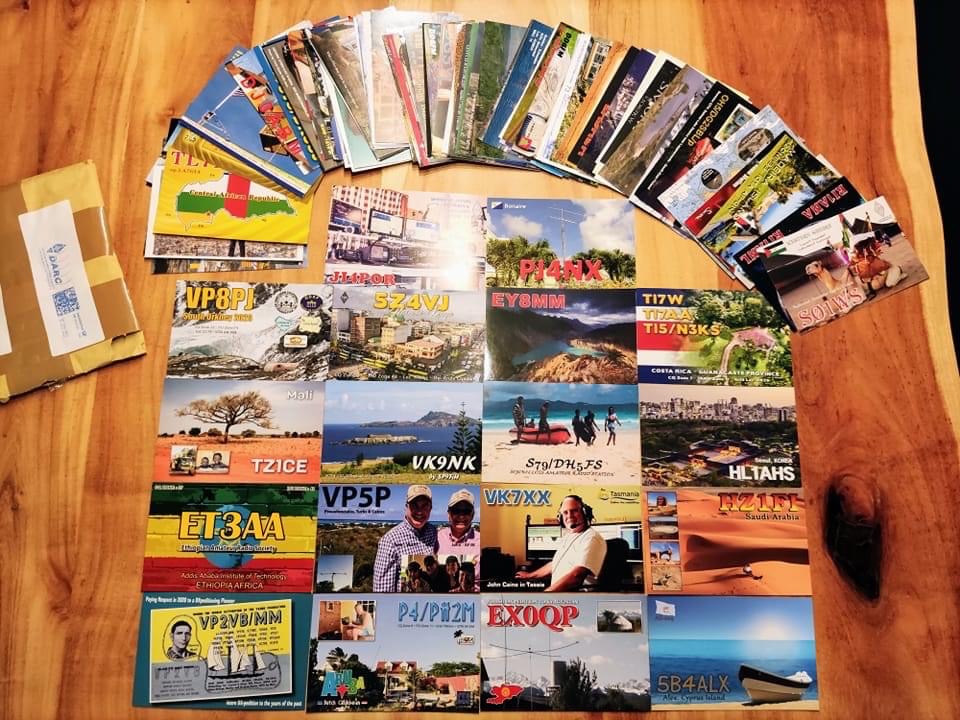
- Collectors item – Paper QSL-cards are kind of a cool thing, a genuine paper QSL-card can be considered as a collector item.
Nowadays more and more QSL are sent digitally via the Internet, although a genuine paper QSL card stays that cool and sometimes even exotic thing in the palm of your hand.
The QSL Card: More Than a Century of History in Amateur Radio
When a radio amateur brings out their card collection, memories often surface of distant connections, special contacts, and sometimes even lifelong friendships. To outsiders, a QSL card may seem like just a piece of cardboard with some data on it, but to radio amateurs it represents much more.
The QSL card has been an important part of our hobby for over a century and grew into a worldwide symbol of amateur radio.
What Does QSL Mean?
The abbreviation QSL comes from the so-called Q-codes. These codes were developed in the early days of wireless telegraphy to make communication faster and more efficient. Especially in Morse telegraphy, this proved to yield enormous time savings.
The meaning of QSL is:
“I confirm receipt.”
Some examples:
- QSL? = Can you confirm receipt?
- QSL = I confirm receipt.
- QSL via bureau = Confirmation will be sent via the QSL bureau.
Although the Q-codes were originally developed for Morse code, they are still used today, both in voice communications and in digital modes.
The Early Years of Radio
To understand the origin of the QSL card, we must go back to the beginning of the twentieth century. In that period, wireless communication was still in its infancy. Pioneers like Marconi experimented with radio waves and proved that messages could be sent without wires.
When the first radio amateurs began building their own transmitters, a new problem arose. How did one know for sure that a signal had actually been received?
Today we send a message via WhatsApp and immediately see two blue checkmarks. In the early years of radio, such a thing obviously didn’t exist. When an amateur transmitted a signal, he often didn’t know whether anyone had actually heard him.
The First Receipt Confirmations
In the early period, receipt confirmations were usually sent by letter. When a listener or radio amateur had received a station, he would send a written message stating:
- Which transmitter he had heard;
- On which date;
- At what time;
- On which frequency;
- With what signal strength.
These confirmations were often simple postcards or handwritten messages. Soon the idea arose to use standardized cards for this purpose. Thus the predecessor of the modern QSL card was born.
The First Real QSL Cards
The oldest known amateur radio QSL cards date from approximately 1916 to 1919 in the United States. These early cards were remarkably simple. They usually only listed:
- The call letters;
- The location;
- Date and time;
- A brief receipt confirmation.
No one could have imagined then that these simple cards would grow into a tradition that still exists more than a hundred years later.
The Rise of International Amateur Radio
During the 1920s, amateur radio grew rapidly. Radio amateurs managed to bridge ever greater distances and made connections between different countries and even continents for the first time.
For such exceptional contacts, people wanted tangible proof. The QSL card thus became not only a receipt confirmation, but also a memento of a special achievement. More and more amateurs began having their cards professionally printed. What started as a simple confirmation slowly grew into a personal calling card.
A Calling Card of the Radio Station
From the 1930s onward, QSL cards became increasingly creative. Radio amateurs added photos of:
- Their shack;
- Their transmitting installation;
- Their antenna mast;
- Their hometown;
- Local landmarks.
Some cards were true works of art. The QSL card became a way to introduce yourself and your station to the rest of the world. For many amateurs, receiving an exotic card from a faraway country was at least as exciting as making the connection itself.
The Golden Era of the QSL Card
Between the 1950s and 1990s, the QSL card reached its peak. International mail was affordable and virtually every radio amateur sent cards. Thousands of cards found their way across the world daily.
Many amateurs built impressive collections with cards from:
- Europe;
- North and South America;
- Africa;
- Asia;
- Oceania;
- Antarctica.
A wall full of QSL cards was often seen as proof of years of radio activity and experience.
QSL Bureaus Make It Affordable
Because sending cards to all corners of the world could become expensive, so-called QSL bureaus emerged. These organizations collected large quantities of cards and sent them in bulk to other countries. This allowed radio amateurs to exchange cards worldwide at a much lower cost. Even today, many associations and national organizations still use this system.
DXCC and Other Awards
The QSL card gained an additional function. It became the official proof for earning radio amateur awards. Well-known examples include:
- DXCC (100 confirmed countries);
- Worked All Continents;
- Worked All States;
- IOTA (Islands On The Air).
For such distinctions, one had to be able to present physical QSL cards as proof of the connections made, for years on end.
What Appears on a QSL Card?
Although the design can vary greatly, most cards contain the same basic information:
- Callsign of both stations;
- Date;
- UTC time;
- Frequency or band;
- Mode (CW, SSB, FM, FT8, etc.);
- Signal report (RST);
- Name of the operator;
- QTH (location);
- Any remarks.
Many amateurs also include:
- Transmit power;
- Type of antenna;
- Type of transceiver;
- Personal message.
The Arrival of the Digital Age
With the rise of the internet, the way connections are confirmed also changed. Digital systems such as Logbook of The World (LoTW) and eQSL make it possible to confirm connections electronically. This allows awards to be granted more quickly and easily.
Yet this did not mean the end of the paper QSL card.
Why Do Paper Cards Continue to Exist?
Despite all digital possibilities, many radio amateurs remain loyal to the classic QSL card. There are several reasons for this.
A digital confirmation is practical. A paper card is personal.
When you receive a card from Japan, Australia, Canada, or South Africa, you literally hold a piece of that connection in your hands. For many amateurs, that remains a special feeling.
A Tradition That Lives On
More than a hundred years after the first receipt confirmations, millions of QSL cards are still being exchanged. They tell the story of a hobby that connects people worldwide.
Technology changes constantly. From spark transmitters to software-defined radio, from Morse to digital modes, from paper logbooks to online databases.
But the QSL card persists.
Not only as confirmation of a connection, but also as a reminder of a moment when two radio amateurs, sometimes thousands of kilometers apart, found each other through nothing more than radio waves.
And perhaps that is exactly why the QSL card, after more than a century, remains so beloved within our hobby.